If you are doing B2B sales today and still relying on only one channel to reach prospects, you are making your life harder than it needs to be. Most teams start with either cold email or LinkedIn outreach. They pick one, focus on it, and hope it works. Sometimes it does. Most of the time, results stay inconsistent.
One week’s replies look good. The next week everything drops. Open rates go down. Connection requests stop getting accepted. You start changing scripts, changing tools, changing lists, and still the pipeline does not feel stable.
The real issue is not the copy or the tool. The real issue is that buyers today do not live in one place.
Your potential customers are on LinkedIn. They are also in their email inbox. They move between tools, meetings, messages, and tabs all day. Expecting them to notice you, trust you, and reply to you from just one channel is not very realistic anymore.
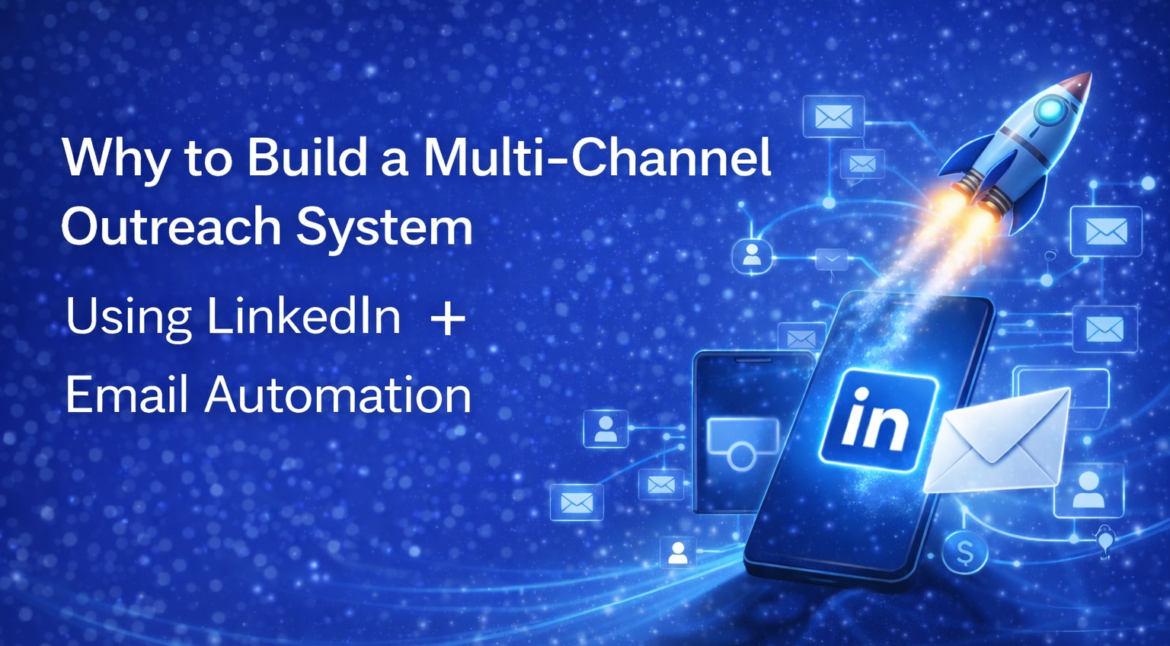
In this blog, we will talk about why combining LinkedIn and email works so well, why automation is necessary if you want to scale it, and how you can build a system that runs every day without burning out your team.
The Real Problem with Single-Channel Outreach
Let us start with something simple. Almost everyone has tried cold email. Many people have also tried LinkedIn outreach. And almost everyone has faced the same cycle.
At first, things look promising. You send a few hundred emails. Some people reply. You book a few calls. Then gradually, things slow down. Open rates drop. Replies become rare. You start wondering if email is dead.
Then you switch to LinkedIn.
You send connection requests. Some get accepted. You send messages. A few people reply. You feel hopeful again. Two months later, the same problem comes back. People stop responding. Your account feels like it is shouting into a crowd.
This does not happen because your product is bad or because your offer is weak. It happens because you are putting all your effort into one place, while your buyers are spread across many.
Some people prefer email. Some people live on LinkedIn. Some people ignore both until they see the same name two or three times.
When you use only one channel, you lose all those chances.
How Buyers Actually Behave Today
Think about your own behavior.
When someone sends you a cold email, do you always reply? Probably not. Sometimes you open it and forget. Sometimes you ignore it. Sometimes you plan to reply later and never do.
Now imagine that a few days later, you see the same person on LinkedIn. You see their profile visit or a connection request. Suddenly, that name feels familiar. You might still not reply, but you are more likely to notice.
Or the other way around. Someone sends you a LinkedIn message. You are busy. You ignore it. A few days later, the same person shows up in your inbox with a clear and relevant email. Now the context is back.
This is how trust starts forming. Not in one message, but in repeated, light, non-pushy touchpoints.
B2B buying is almost never one-touch. It is a series of small interactions that slowly move someone from not interested to curious to ready to talk.
Why LinkedIn and Email Work So Well Together
LinkedIn and email are very different, and that is exactly why they work so well together.
LinkedIn is public. It shows your face, your role, your company, your activity. It makes you look real. When someone clicks your profile, they can see who you are in seconds.
Email is private. It gives you more space. You can explain things better. You can structure your message. You can go a bit deeper into the problem and the solution.
When you combine both, you get the best of both worlds.
LinkedIn builds familiarity and social proof. Email gives you room to explain your value.
Also, people do not check these two channels in the same way. Some people are active on LinkedIn but bad at email. Some people live in email and rarely reply on LinkedIn. By using both, you increase your chances of catching people at the right moment.
The Visibility Effect
There is another simple reason why multi-channel outreach works better. It is visibility.
When someone sees your name once, it means almost nothing. When they see it twice, they might remember it. When they see it three or four times across different places, your name starts to feel familiar.
Familiarity reduces resistance.
You are no longer a total stranger. You are someone they have already seen around. This alone increases reply rates more than most people realize.
This is not about being annoying. It is about being present in a natural and spaced-out way.
Why Doing This Manually Does Not Scale
Now, everything we described sounds good in theory. But if you try to do this manually, you will quickly run into problems.
You have to:
- Track who you emailed
- Track who you sent a connection request to
- Track who accepted
- Track who replied
- Remember when to follow up and where
- Stop messaging people who already responded
Very quickly, things become messy. Spreadsheets grow. Notes get outdated. Someone forgets to follow up. Someone else sends a message to a person who already replied.
This is not a people problem. It is a system problem.
This is where automation becomes necessary, not as a luxury, but as a requirement.
What Automation Actually Does in Outreach
Good automation does not mean sending spam.
Good automation means:
- The right message
- To the right person
- At the right time
- On the right channel
- With proper spacing and logic
It means you design the process once, and the system executes it every day.
A lead enters your system. The system visits their LinkedIn profile. Then it sends a connection request. If they accept, it sends a message. If they do not, it sends an email. If they reply, everything stops and your team takes over.
This is not aggressive. This is organized.
What a Real Multi-Channel Outreach System Looks Like
In a proper setup, your workflow looks something like this:
You upload or capture leads. They get enriched with email and LinkedIn data. They enter a sequence that includes LinkedIn steps and email steps. The system executes those steps over days or weeks. Every action is tracked. Every reply is logged.
Your sales team does not waste time on repetitive tasks. They only focus on replies and conversations.
This is how outbound becomes predictable.
Why Most Teams Fail at This
Most teams fail not because the idea is wrong, but because their tools are disconnected.
They use one tool for LinkedIn. Another tool for email. Another tool for CRM. Another tool for tracking tasks.
Things break. Data does not sync properly. People fall through the cracks. Nobody is sure what happened with which lead.
The more tools you add, the more fragile the system becomes.
How Bixjet Makes This Simpler
This is exactly the problem Bixjet was built to solve.
Instead of stitching together five different tools, Bixjet gives you one place where:
- Your leads live
- Your CRM lives
- Your LinkedIn automation runs
- Your email automation runs
- Your workflows run
You can build one sequence that includes both LinkedIn and email steps. You can see every action in one timeline. You can stop juggling tools and start running a real system.
If you are trying to build a serious outbound motion, this kind of setup saves not just time, but also a lot of mental energy.
And yes, this is also the point where many teams realize they could have done this much earlier.
A Simple Example That Actually Works
Imagine this flow:
- Day one, the system visits the prospect’s LinkedIn profile and sends a connection request.
- Day three, if they accept, the system sends a short and polite message. If they do not accept, it waits.
- Day five, the system sends an email with a clear and relevant message.
- Day eight, a LinkedIn follow-up goes out.
- Day twelve, a second email follow-up is sent.
- Day fifteen, a final light check-in message is sent.
All of this happens automatically. No one forgets anything. No one double-messages. No one spams.
Now compare this to sending one cold email and hoping for the best.
The difference in results is usually not small.
Why This Fits B2B Sales So Well
B2B sales are rarely instant. People need time. They need context. They need to see you more than once.
Multi-channel outreach gives you that without being pushy.
You are not chasing people. You are staying visible in a structured way.
A lot of people think automation means generic messages. That is only true if you do it badly.
Good systems use:
- Dynamic fields
- Company names
- Role-based messaging
- Industry-specific angles
You write the strategy once, and the system applies it at scale.
How to Start Without Overcomplicating It
You do not need a complex setup on day one.
Start with:
- One LinkedIn message
- Two emails
- Two follow-ups
Build one simple sequence. Test it. Improve it. Then expand.
Tools like Bixjet are built exactly for this kind of step-by-step scaling.
What Changes When You Do This Right
Teams who switch to proper multi-channel outreach usually notice:
- More replies
- Better quality conversations
- More consistent pipeline
- Less manual work
- Less stress around prospecting
Sales stops feeling random.
The Direction B2B Sales Is Already Moving Toward
The future is not about sending more messages.
It is about building better systems.
Systems that run every day. Systems that follow logic. Systems that support your team instead of exhausting them.
Final Thoughts
If you are still relying on only LinkedIn or only email, you are leaving results on the table.
Combining both in one automated system is not a growth hack anymore. It is the new baseline.
And once you experience how smooth and predictable this can be, it becomes very hard to go back to the old way of doing things.