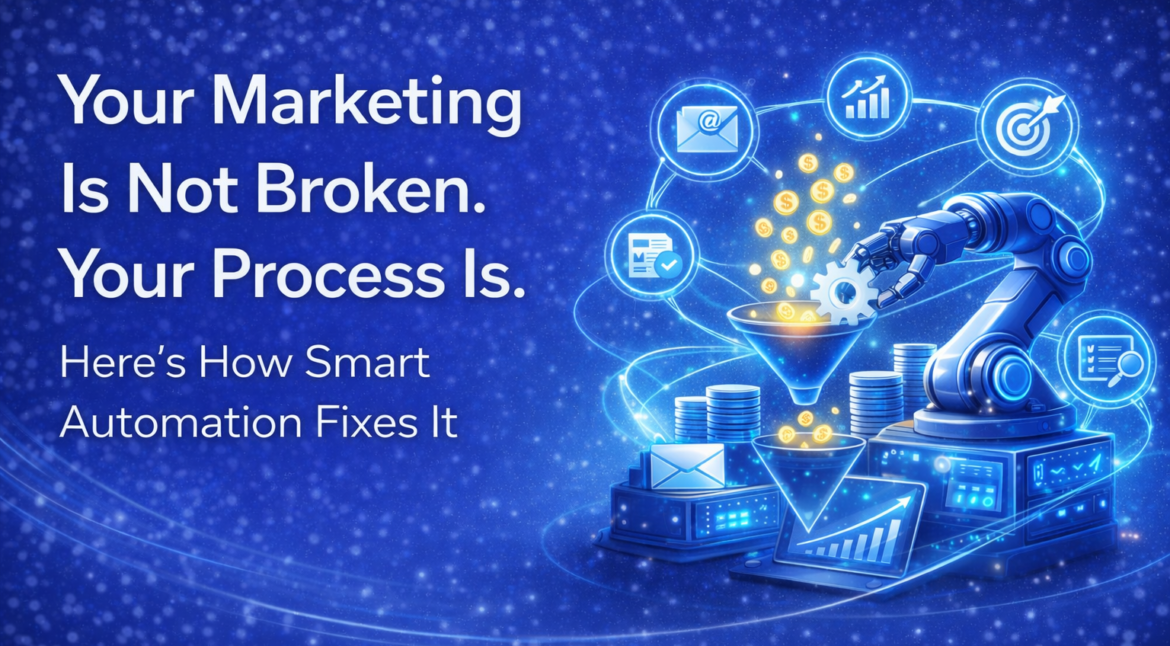
If your marketing feels exhausting, inconsistent, and strangely unpredictable, you are not alone. One week you get a spike in leads. The next week it is quiet. Campaigns start with excitement and end in confusion. Your team is busy all day, yet the results do not always match the effort.
It is tempting to blame the channel. Maybe social media is saturated. Maybe email is dead. Maybe ads are too expensive. Maybe your audience is not responding.
But in most businesses, the real issue is not the marketing itself.
Your marketing is not broken. Your process is.
When the process behind your marketing is messy, manual, and disconnected, even great ideas struggle to perform. When the process is clear, consistent, and supported by smart automation, even small marketing teams can produce big, repeatable outcomes.
This article will explain what is really going wrong behind the scenes and how smart automation fixes it without turning your brand into a cold robot.
The Real Problem: Marketing Without a System
Many teams are running marketing like a series of one-time events. Launch a campaign. Post a few updates. Send a few emails. Run some ads. Then move on.
That is not a system. That is a sequence of activities.
A system is different. A system turns effort into repeatable outcomes. It ensures that when someone shows interest, the next step is clear. It ensures follow ups happen. It ensures leads are tracked. It ensures every campaign feeds the next one.
Without a system, marketing becomes dependent on memory, energy, and constant manual pushing. It is like trying to fill a bucket with a hole in it. You can pour more water, but you will still lose most of it.
This is why so many teams feel like they are always starting from zero.
Symptoms Your Process Is the Bottleneck
If you are wondering whether process is your real problem, look for these signals.
First, leads are coming in, but they are not converting consistently. That usually means people are not being nurtured properly or follow ups are not happening on time.
Second, you are doing a lot of work that does not scale. Copying data between tools, manually tagging leads, creating reminders for follow ups, and building reports by hand are all signs of a broken process.
Third, your team spends more time managing tools than marketing. When your stack is disconnected, you end up doing the integration work yourself. You become the glue between systems that were never designed to work together.
Finally, results depend on specific individuals. When one person goes on leave or gets busy, performance drops. That is a process issue. A good system should protect results from human inconsistency.
Why Manual Marketing Breaks at Every Stage
Marketing has a journey. From first touch to sale, people move through stages. The stages do not need to be complex, but they do need to be supported.
Manual marketing often breaks at the same points.
It breaks at the top when you do not capture leads properly. People click, read, and leave. Forms go unanswered. DMs are missed. Website visitors disappear without ever being added to a nurture flow.
It breaks in the middle when there is no consistent follow up. Some leads get attention. Others are forgotten. Timing becomes random. And timing matters because interest fades quickly.
It breaks at the handoff between marketing and sales. Marketing generates leads, but sales does not know what those leads engaged with. Or sales follows up too late. Or sales cannot prioritize because everything looks the same.
It breaks after the sale too. Customers are not nurtured, upsells are missed, referrals are never requested, and retention relies on reactive support instead of proactive communication.
None of these failures mean your marketing is bad. They mean your process is leaking opportunities.
What Smart Automation Actually Does
Smart automation is often misunderstood. People imagine robotic messages, spammy sequences, and generic campaigns that feel soulless.
That is not smart automation. That is lazy automation.
Smart automation is simply the use of systems that respond to behavior, reduce human error, and keep the customer journey moving without constant manual effort.
Instead of you remembering everything, your system remembers.
Instead of someone manually updating records, your system updates them.
Instead of leads falling into silence, your system triggers the right next step.
Smart automation is not about sending more messages. It is about sending the right message at the right time and ensuring nothing important gets missed.
How Smart Automation Fixes the Process
The first way automation fixes your process is by creating consistency. When every lead follows the same basic journey, you stop relying on guesswork. Someone downloads a resource, they enter a nurture flow. Someone replies to an outreach message, they are tagged and moved into a follow up stage. Someone books a call, reminders and prep steps are triggered automatically.
Consistency builds trust. It also makes results predictable.
The second way automation fixes your process is by improving speed. Leads are most responsive when interest is fresh. If your system responds instantly, sends a follow up the next day, and schedules reminders for your team, you win more conversions without working harder.
The third way is visibility. When everything is tracked, you stop guessing. You know where leads are coming from. You know what messages are working. You know where deals get stuck. You know what stage needs improvement. Visibility turns marketing into a measurable machine instead of a stressful mystery.
The fourth way is scale. With automation, you can handle more leads and run more campaigns without adding chaos. Your team stays focused on creative work and strategy instead of admin work.
The Myth That Automation Kills Personalization
A lot of teams avoid automation because they fear losing the human touch. That fear is valid, but it comes from the wrong assumption.
Personalization is not about typing every message manually. Personalization is about relevance.
If your automation is designed around real intent and behavior, it can feel more personal than a rushed manual message.
A lead who visits your pricing page twice needs a different message than a lead who just read a blog post. A founder who replied with a question needs a different sequence than someone who did not respond. Smart automation allows you to build these paths so that your communication matches the context.
That is how you scale personalization without burning out.
A Practical Example of a Smarter Process
Imagine a simple funnel.
A lead engages with your LinkedIn content and clicks your offer. They fill a form. Instantly, they receive a useful resource and a short message that sets expectations. Over the next few days, they receive a series of relevant follow ups that answer common questions and share proof.
If they click specific links, the system tags them as high intent. Your sales team gets notified and sees the lead’s activity history. They follow up with a message that references what the lead engaged with. It feels personal because it is informed.
If the lead books a call, reminders and calendar confirmations go out automatically. After the call, the lead is moved into the next stage and follow ups are scheduled based on outcome.
That is a process. That is what automation supports.
Without automation, each step depends on someone remembering to do it. That is why things slip.
How to Start Without Overcomplicating It
If you want to implement smart automation, start small.
Start by mapping your customer journey. What are the key stages from first touch to conversion. Where do leads usually drop off. Where do delays happen. Where do tasks repeat.
Then choose a few automations that remove friction. For example, instant lead capture, follow up sequences, pipeline stage tracking, and reminders.
Avoid automating everything at once. The goal is clarity, not complexity. A small number of well-designed workflows will outperform a complicated maze.
Why Bixjet Makes This Easier
The hardest part of automation is not the idea. It is execution across disconnected tools.
When your CRM lives in one place, your outreach in another, your follow ups in a third, and your reporting in a spreadsheet, automation becomes difficult and fragile. Things break. Data gets lost. Teams stop using the system.
Bixjet is built to simplify this.
It helps you manage leads, run outreach, automate follow ups, and track your pipeline in one place so your process stays connected. Instead of patching together a workflow from multiple tools, you can build a clean system that supports marketing and sales together.
That is where real efficiency comes from.
Final Thoughts
If your marketing feels inconsistent, the answer is not always more content, more ads, or more hustle.
Often, the answer is a better process.
Smart automation fixes the leaks, creates consistency, improves speed, and gives you visibility into what is actually working. It makes your team more effective without making your brand feel robotic. And it gives you the freedom to focus on strategy, creativity, and relationships instead of constant manual follow up.
Your marketing is not broken. Your process is.
Ready to Fix the Process?
If you want to build a marketing system that captures leads, follows up automatically, and turns interest into a predictable pipeline, it is time to use a platform designed for smart automation.
Try Bixjet today and turn your marketing into a repeatable growth engine.